
Try these: Ahmedabad street stalls will no longer be able to sell non-vegetarian food; two other major cities of Gujarat Vadodara and Rajkot have directed vendors to cover non-vegetarian items; Meat shops in Gurugram are not allowed to open on certain days; and a municipal company in Delhi does not want non-vegetarian items to be prominently displayed.
These are just a few examples of the many attempts to regulate Indian eating habits. And this continues, although several reports indicate that over 70 percent of Indians consume items like fish, meat, or eggs.
Also, despite known nutritional values, nearly a dozen states don’t allow eggs as part of lunch at school. Analysis by the India Today Data Intelligence Unit (DIU) shows that countries with fewer non-vegetarian populations are the most reluctant to include eggs on their menu.
Reading | Meat Display Prohibition: A Brief History of the Non-Vegetarian Eating Advocacy in Gujarat
The decision to include eggs in children’s meals has been debated in the country recently. While the Madhya Pradesh government removed eggs from meals, Karnataka added the same.
The Indian love for meat
The vegetarianism debate in India is never old. Data from the National Family Health Survey 4 (https://ift.tt/3DH9c3O) suggests that 70 percent of women and 78 percent of men in the country consume meat.
Telangana, Andhra Pradesh, West Bengal, Tamil Nadu, Odisha and Jharkhand are states where the proportion of non-vegetarians is over 97 percent. In contrast, Punjab, Haryana, Gujarat and Rajasthan have the lowest non-vegetarian populations (below 40 percent), Show government data.
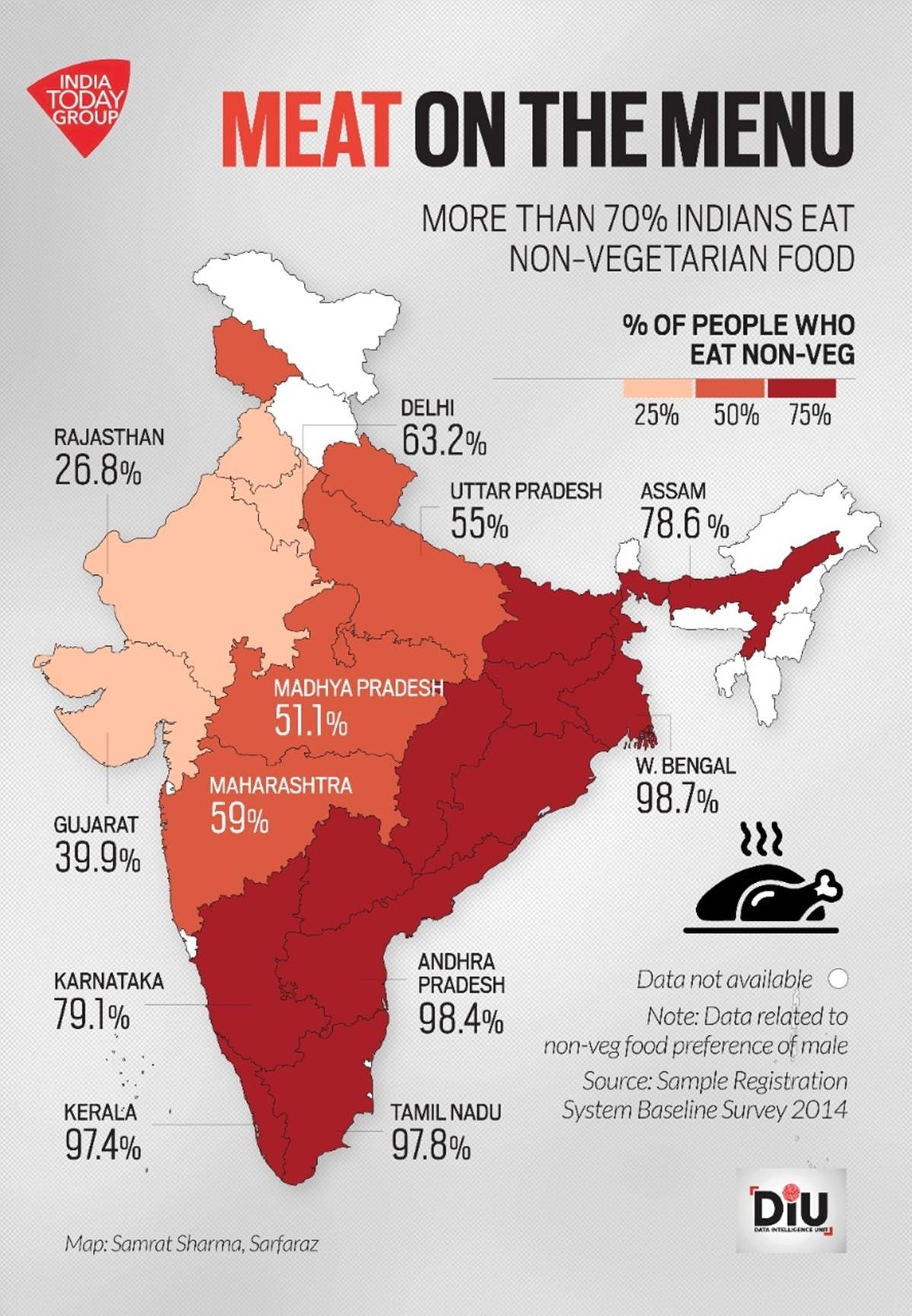
Meat consumption in India, as elsewhere, has grown with rising incomes. India consumed six million tons of meat in 2020, according to OECD. Almost half of the population in India eats non-vegetarian meals once a week.

Incidentally, there are only nine states, including West Bengal and Kerala, that have no restrictions on meat consumption. Most other states have restrictions depending on the type of meat.
India the meat house
India accounts for 2.18 percent of world meat production and ranks sixth after China, the USA, Brazil, Russia and Germany Ministry of Food Industry.
Meat production in India grew 5.15 percent from 2014-15 through 2019-20, according to the Ministry of Fisheries, Animal Husbandry and Dairy Farming.
Buffalo make up about 30 percent of India’s total meat production. Among the states, Uttar Pradesh (15 percent), Maharashtra (13 percent) and West Bengal (10 percent) have the largest share of meat production in India, according to the RBI.

Meat trade immune to pandemic
While the Covid pandemic left the economy in tatters, the meat industry reportedly remained unscathed.
“Covid-19 has no negative impact on the export business of buffalo meat from India. It is on the right track and runs smoothly with no hurdles in the supply chain. Despite the effects of the pandemic, India had an export value of 3.17 billion in April 2020-March 2021 Ministry of Commerce and Industry said in July.
With over 70 countries as an export destination, India is one of the largest exporters of buffalo meat worldwide. Of the 10 largest buffalo meat exporters from India in 2018-19, seven were from Uttar Pradesh, two from Maharashtra and one from Delhi, trade and industry ministers Piyush Goyal had said in response to a question in Lok Sabha in December 2019.
According to OECD data, meat consumption in India has decreased since 2010, but increased again after 2014. While the consumption of chicken and other poultry products increased steadily, consumption of buffalo meat only picked up again after 2014. India consumed six million tons of meat in 2020.
Also read | Gujarat CM says “no problem” with non-vegetarian food, even when street vendors call for help
एक टिप्पणी भेजें